Home

Question & Answer

Stimulus Package Stimulates Church-State Debate

Friday, March 6, 2009

Barack Obama
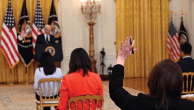
Barack Obama signs the $787 billion American Recovery and
Reinvestment Act Bill on Feb. 17, 2009.

The economic stimulus legislation signed into law on Feb. 17, 2009, by President Barack Obama authorizes state governments to fund the "modernization, renovation and repair" of buildings on public and private college and university campuses. But the provision prevents these schools from using this funding to improve buildings that are "used for sectarian instruction or religious worship," or those "in which a substantial portion of the functions of the facilities are subsumed in a religious mission." To explore the legal implications of this restriction, the Pew Forum turns to church-state scholar Robert Tuttle.

Featuring:
Robert W. Tuttle, David R. and Sherry Kirschner Berz Research Professor of Law and Religion, The George Washington University Law School

Interviewer:
Jesse Merriam, Research Associate, Pew Research Center's Forum on Religion & Public Life


Question & Answer

forum logo More from the Pew Forum

Graphic: Religious Groups Agree: Fixing the Nation's Economy Is Job One
Q&A: Faith-Based Hiring and the Obama Administration
In Brief: Hein v. Freedom From Religion Foundation
Q&A: Controversy Over the Blaine Amendments

Digg It! del.icio.us reddit google newsvine

More: Research, news, blogs

Some religious-liberty advocates have expressed concern about whether the recent stimulus legislation might require colleges and universities to prohibit religious student groups from meeting or worshipping in any campus buildings that are funded with money from the stimulus package. Does the legislation actually require this?

I don't think that the restriction needs to be interpreted to require that a college or university prohibit a religious student group from using a room in a government-funded campus building. Instead, the restriction could be interpreted to require only that schools not officially designate space in the government-funded buildings specifically for religious activities.

This interpretation would follow the ruling in a 1971 Supreme Court case, Tilton v. Richardson, which involved the federal government's funding of building construction at four religious colleges and universities in Connecticut under the Higher Education Facilities Act of 1963. The court in Tilton upheld the constitutionality of this funding and specifically declared that the Establishment Clause in the First Amendment to the U.S. Constitution only prohibited the schools from officially designating space in their government-funded buildings for religious activities, such as religious instruction or worship. This interpretation of the restriction seeks to reflect the standard that was articulated in Tilton.

Schools can easily satisfy this interpretation by making the rooms available to all student groups on an equal basis. In this instance, a school's only official use of the room is to make it equally available to all student groups. The school is therefore not responsible for a student group's decision to use the room for religious instruction or worship.

If, however, a school itself sponsored religious instruction or gave religious student groups preferential access to a space in a government-funded building, then the school might be considered officially responsible for this religious use of the room, and therefore in violation of the restriction in the stimulus legislation as well as the Establishment Clause.

What if a college or university did strictly interpret the provision in the stimulus legislation to deny a religious student group access to a campus building because the group was going to use the building for a religious activity? Would this denial violate the Constitution?

First of all, I think it's highly unlikely that university officials would adopt this strict interpretation of the stimulus legislation. But if they did, then the issue would turn on whether the institution is a public or private university.

The Free Speech Clause of the First Amendment to the U.S. Constitution prohibits government officials and entities, including public universities, from discriminating against individuals on the basis of the content of their speech. The Free Speech Clause does not limit the actions of private individuals or institutions, including private universities. This is true regardless of whether the private university receives government funding for its buildings. So even if a private institution received government funding under the stimulus package, the school would not violate the Free Speech Clause by prohibiting religious use of those government-funded buildings.

If a public university were to do this, however, then a court would likely rule that the public university's prohibition on any religious use of the building violated the Free Speech Clause. An important case on this point is Widmar v. Vincent (1981). In the case, the Supreme Court held that a public university violated the Free Speech Clause by barring a religious student group from meeting in university buildings while at the same time allowing non-religious student groups to meet in the same facilities. In defending its exclusion of the religious group, the university claimed that it excluded all religious groups, not just this group in particular. Moreover, the university argued, the Establishment Clause required this exclusion because allowing religious student groups to meet in public buildings would amount to an unconstitutional public funding of religion. The court disagreed and held that the university would not violate the Establishment Clause as long as it gave religious student groups equal access to university facilities. The court further explained that prohibiting all religious groups from using government-funded university buildings in fact violated the Free Speech Clause.

As I mentioned above, however, I think it is very unlikely that a similar case would arise from the stimulus legislation because I don't think a public college or university would interpret the stimulus legislation to require the exclusion of all religious groups from the school's government-funded buildings. Still, given the ambiguity of the stimulus law provision, the Department of Education (the federal agency that oversees federal funding of colleges and universities) might perform a useful service by letting schools know that the stimulus legislation does not prohibit students from using space in government-funded buildings for religious purposes.

Related Articles


Pew Research Center

March 3, 2009
The New Obama Narrative: 'Change' Was an Understatement

Project for Excellence in Journalism

Feb. 9, 2009
Support for Stimulus Plan Slips, But Obama Rides High
Pew Research Center for the People & the Press

Feb. 27, 2009
Truth Over Happiness
Pew Research Center for the People & the Press

News

Feb. 24, 2009
A New Tradition for Obama's Presidential Events: Opening With a Prayer
U.S. News & World Report

Feb. 16, 2009
Christians on Left, Right Push Plan to Aid the Poor
The Wall Street Journal

Feb. 10, 2009
Huckabee: Stimulus is 'anti-religious'
The Politico


Blogs

March 4, 2009
The depression's silver lining
Rod Dreher 

Feb, 11, 2009
Is the Stimulus Package 'Anti-Religion'?
Steven Waldman 

Feb. 9, 2009
The Meaning of Separation
Spiritual Politics


Photo credit: AP


This transcript has been edited for clarity, spelling and grammar.


Religious Landscape Survey

Email Newsletter

Stay informed with weekly updates from the Pew Forum.

See Newsletter Archive